UP Chief Minister Yogi Adityanath accuses opposition leaders of favouring Bangladeshi infiltrators; sharp political exchanges intensify ahead of 2027 Assembly polls
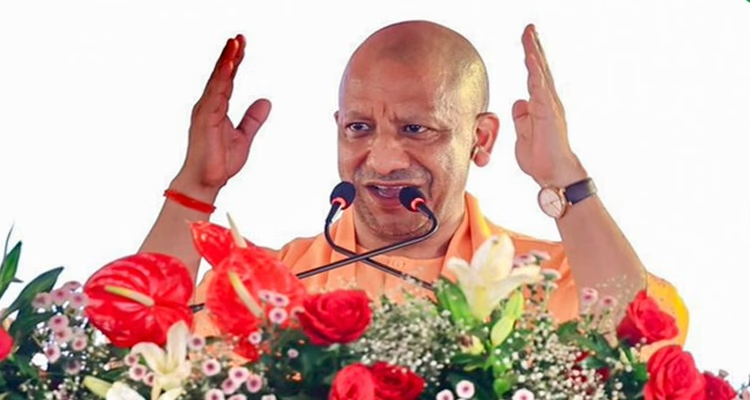
Kanpur: Uttar Pradesh Chief Minister Yogi Adityanath launched a sharp attack on Congress leader Rahul Gandhi and Samajwadi Party president Akhilesh Yadav during a public programme in Kanpur, describing them as “Bade Miyan” and “Chhote Miyan” and accusing them of showing excessive sympathy towards alleged Bangladeshi infiltrators.
Addressing a gathering in the Bithoor area on Maharshi Valmiki Jayanti, Adityanath targeted the two opposition leaders over their alleged stand on illegal immigration, claiming that they were more concerned about infiltrators than the rights and welfare of India’s poor, Dalits, farmers and unemployed youth.
The Chief Minister used “Bade Miyan” to refer to Rahul Gandhi and “Chhote Miyan” for Akhilesh Yadav, turning his address into a pointed political attack on the Congress and the Samajwadi Party ahead of the 2027 Uttar Pradesh Assembly elections.
Adityanath questioned the Samajwadi Party chief’s position on alleged illegal immigration and accused opposition parties of protecting infiltrators instead of prioritising the interests of Indian citizens. He alleged that illegal immigrants were obtaining ration cards and access to government welfare schemes, potentially depriving eligible beneficiaries of resources.
देश के अंदर दो मियां हैं- एक ‘छोटे मियां’, एक ‘बड़े मियां’
ये बांग्लादेशी घुसपैठियों को गले लगाते हैं और दलितों, वंचितों, गरीबों, अन्नदाता किसानों एवं युवाओं का अपमान करते हैं… https://t.co/NcLTMD1Csg
— Yogi Adityanath (@myogiadityanath) October 26, 2026
He also linked the issue to the Special Intensive Revision (SIR) of electoral rolls, alleging that names of infiltrators had found their way into voter lists. These claims formed part of his political argument, although the allegations of electoral irregularities and misuse of welfare benefits require independent verification.
CAA and illegal immigration become political flashpoints
Adityanath also criticised the Congress and the Samajwadi Party over their opposition to the Citizenship Amendment Act (CAA). The legislation provides a pathway to Indian citizenship for eligible Hindu, Sikh, Buddhist, Jain, Parsi and Christian migrants from Afghanistan, Bangladesh and Pakistan who entered India on or before December 31, 2014, subject to the law’s conditions.
The Chief Minister argued that opposition to the legislation reflected a failure to protect persecuted religious minorities. The CAA, however, remains a contentious political issue, with its supporters defending it as a humanitarian measure and critics raising concerns about its religious criteria and constitutional implications.
The BJP has repeatedly highlighted illegal immigration as a matter of national security, demographic concern and pressure on public resources. Opposition parties, meanwhile, have challenged various aspects of the ruling party’s approach to citizenship, voter verification and minority rights.
Attack on opposition’s governance record
Adityanath broadened his criticism to the previous governments led by the Samajwadi Party and the Congress, accusing them of failing to address unemployment, poverty, farmers’ concerns and women’s security.
He alleged that Uttar Pradesh had witnessed lawlessness, land-grabbing and the protection of criminal elements under previous administrations. The Chief Minister contrasted that period with his government’s claims of improving law and order, strengthening infrastructure and expanding welfare delivery.
Taking a swipe at Akhilesh Yadav’s political legacy, Adityanath maintained that political power could not be sustained merely through family connections and that public confidence had to be earned through performance and accountability.
The remarks reflect the BJP’s broader strategy of presenting the 2027 Assembly election as a contest over governance, law and order, national security and the protection of public resources.
Development projects announced in Kanpur region
The programme also featured development announcements, with the Chief Minister inaugurating and laying the foundation stones for projects worth more than ₹411 crore in the Bithoor and Bilhaur Assembly constituencies.
The combination of development initiatives and political criticism underscored the BJP’s effort to showcase its governance record while sharpening its attack on the opposition.
Political battle lines harden ahead of 2027
The confrontation comes amid growing political tensions over alleged infiltration, citizenship and electoral-roll revision. The BJP has sought to make these issues central to its political messaging, while the Congress and the Samajwadi Party have continued to challenge the ruling party on governance and constitutional questions.
Adityanath’s “Bade Miyan-Chhote Miyan” jibe added a personal dimension to the dispute, bringing Rahul Gandhi and Akhilesh Yadav together as targets of his criticism.
With the Uttar Pradesh Assembly elections approaching in 2027, the debate over illegal immigration, voter-list scrutiny, welfare benefits and law and order is expected to remain prominent. The electoral impact of these issues will ultimately depend on public perception, the evidence supporting political claims and the performance of the rival parties.